COMPANY
Home
Where We Build
About Us
Contact Us
Vendor Inquiry

By Mitch Howard, Warranty, Dunn & Stone Builders. Reviewed June 2026.
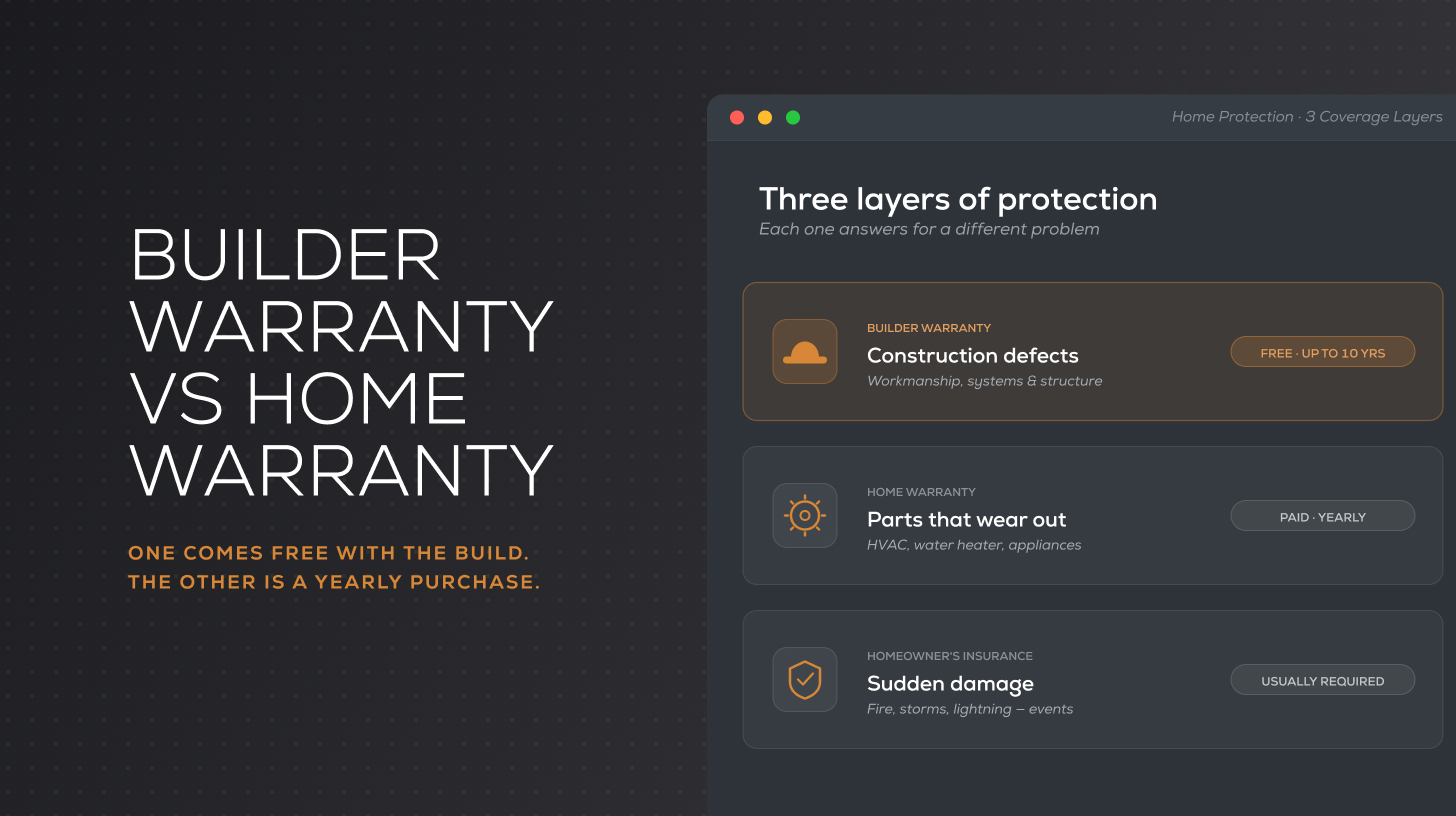
A builder warranty comes free with a newly built home and covers defects in how the home was built. A home warranty is a paid service contract that covers appliances and systems when they wear out.
The builder warranty answers for how your home was built. A home warranty helps once parts break down from normal use.
I run warranty service at Dunn & Stone. When something needs fixing after you move in, I am the one who comes to your home. We build custom homes around Houston, and we service our own warranties, so I see where buyers confuse these two kinds of coverage.
Here is how they compare, how long each one lasts, and whether a brand-new home needs both.
A builder warranty is the guarantee that comes with new construction. It is built into the price of the home, with no premium and no service fee.
Coverage runs in tiers, tied to the kind of problem and when it shows up after you move in. Most builders, including us, follow a structure people call 1/2/10.
In our homes, the first year covers the house top to bottom. The second year covers the mechanical systems inside the walls. Structural coverage runs up to ten years on the foundation and framing.
We service all of that ourselves. We also keep a third-party structural backer, StrucSure, in place as added protection if anything ever happened to us. It is there for you even though we handle every claim directly.
A builder warranty stands behind construction, not the parts that age out. It will not cover your household appliances or small cracks in brick and drywall. It also skips any component that already carries a manufacturer's warranty.
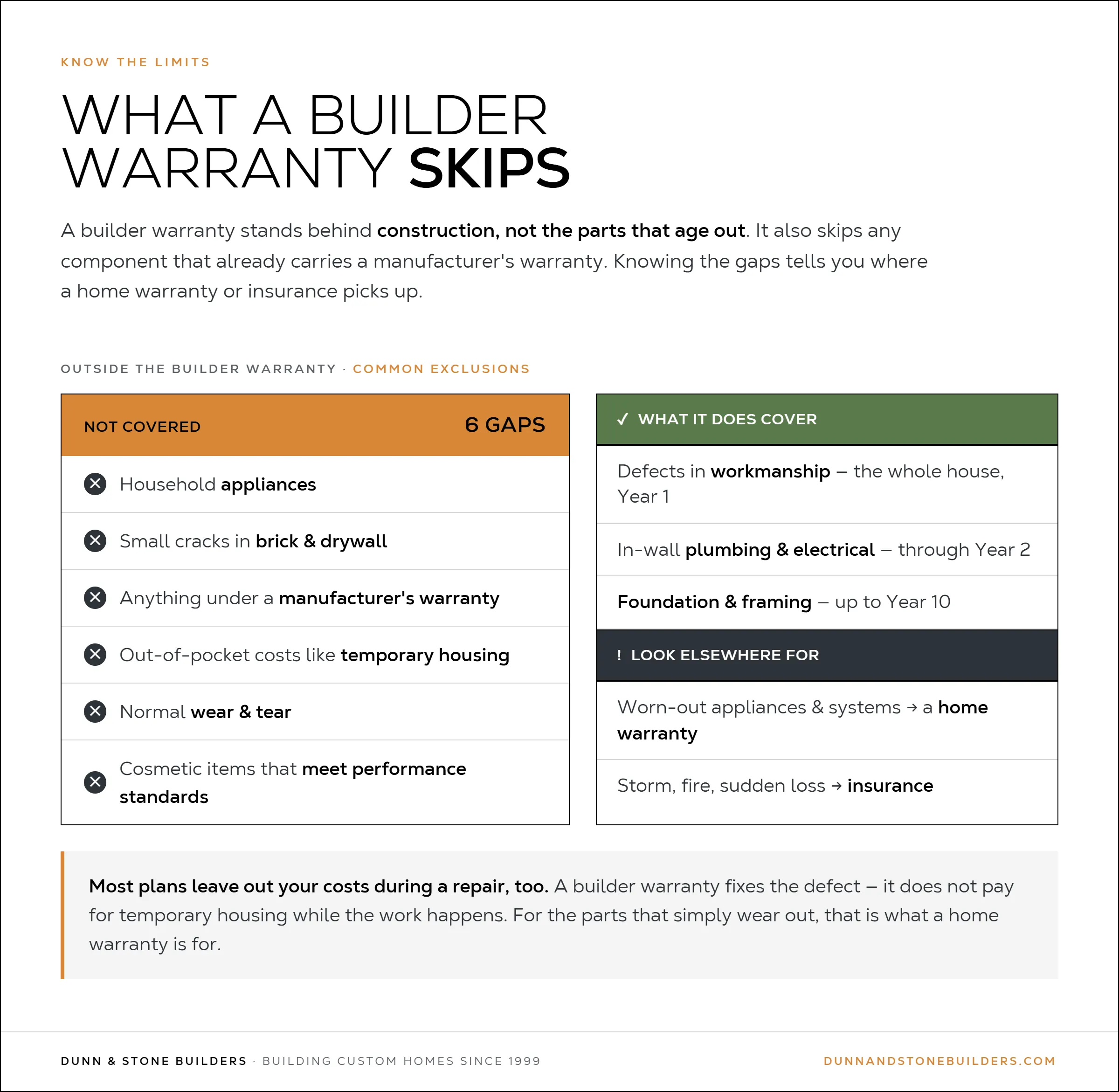
Most plans leave out your out-of-pocket costs during a repair, such as temporary housing while we work. The FTC lays out these common limits in its guide for new homes.
A home warranty is a service contract. You pay an annual premium, plus a service fee each time a technician comes out. In return, the plan repairs or replaces covered items when they fail from normal use.
It works on a home of any age, and it shows up most often on older or resale homes. Typical plans cover the HVAC, water heater, plumbing, and kitchen appliances. Coverage caps and exclusions vary a lot between companies, so the contract details matter.
Our guides on comparing home warranty companies in Texas and whether a home warranty covers HVAC go deeper on this. Coverage for specific items, like windows, often depends on the fine print.
The split is about what goes wrong and who stands behind the fix. A builder warranty answers for defects in how the home was built. A home warranty answers for parts that wear out from daily use.

Timing separates them too. A builder warranty arrives with the home and winds down over the years. A home warranty is a yearly purchase you renew for as long as you want coverage.
With a builder warranty, you call the builder. With a service contract, you call the warranty company.
Homeowner's insurance covers sudden, accidental events like fire or storm damage. A warranty covers repairs from defects or wear, not disaster damage. Your lender usually requires insurance, while a home warranty stays optional.
Here is an example I give buyers. A lightning strike near the home can damage several systems at once. That falls to insurance, not to a builder warranty or a service contract.
While your home is still going up, a separate policy called builder's risk insurance covers it during construction.
In the early years, probably not. Your builder warranty already covers construction defects, so a service contract often pays for protection you already hold.
The honest exception ties back to your insurance. A strong homeowner's policy already picks up things like that lightning strike. If your policy leaves gaps that matter to you, a service contract can be worth a look.
Once builder coverage narrows and your appliances age, a home warranty starts to make more sense. We do not sell warranty add-ons ourselves, so this is the advice I give with nothing to gain from it.
When something comes up, the path should be short. You reach out, and we handle the repair. A phone call or a quick text to our field team works, whatever is easiest. We keep red tape out of it.

We sort claims by urgency. For an emergency like a plumbing or AC failure, we aim to resolve it within 24 hours. For non-urgent items, our target is 20 days or less, depending on when we can get into the home.
Part of my job is finding trouble early. When a problem shows up in one home, we learn from it and adjust how we build the next one.
Not everything is covered, and we say so plainly. In the first year, most claims are cosmetic items that already meet our performance standards. The owner feels something should look or work better.
When the cost is reasonable, we fix it anyway. That after-closing support is where our referrals come from.
A service contract runs differently. You call the company, pay the service fee, and wait for an assigned contractor. Before you sign with any builder, it helps to know the right questions to ask a home builder about warranty service. A blue tape walkthrough helps you catch items before you close.
Texas changed the math for builders in 2023. A law called HB 2024 created a six-year statute of repose, the outside deadline a homeowner has to bring a construction defect claim. It took effect on June 9, 2023, and applies to work and contracts from that date forward.
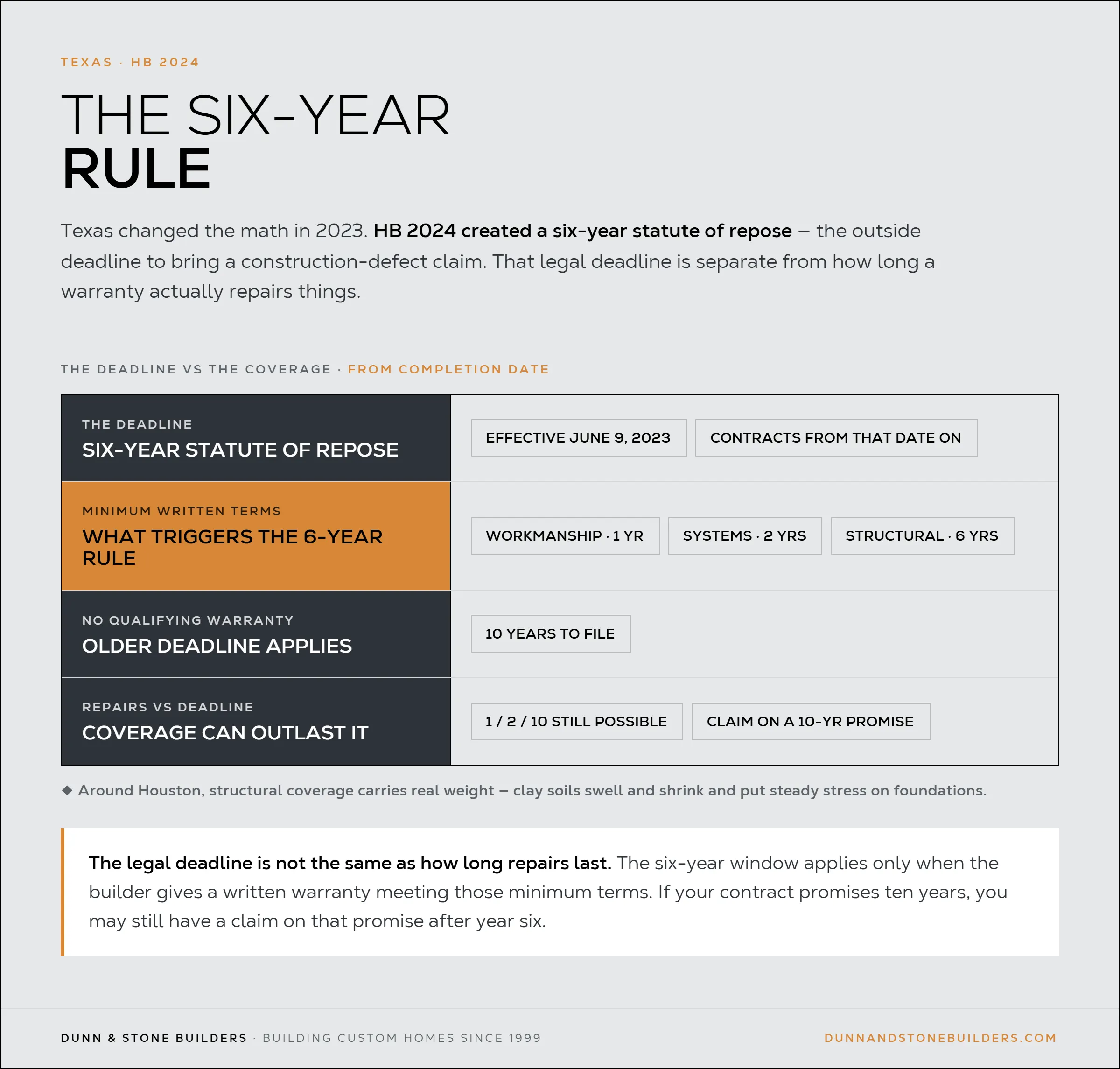
The shorter window applies only when the builder provides a written warranty with set minimum terms. Those terms are one year on workmanship, two years on systems, and six years on major structural components. Without that qualifying warranty, the older ten-year deadline still applies.
That legal deadline is separate from how long a warranty repairs things. A builder can still cover structural components for the full ten years, which is what a 1/2/10 structure does. If your contract promises ten years, you may still have a claim on that promise after year six.
Around Houston, structural coverage carries real weight. Our clay soils swell and shrink with the seasons and put steady stress on foundations.
Often it does, within the coverage term, though it depends on the warranty. Structural warranties backed by a third party are commonly written to follow the home to the next owner. Builder-direct coverage varies more.
If you are buying or selling a newer home, read the warranty documents for the transfer terms. The coverage period runs from the original completion date, not from the date you bought the home.
No. A builder's warranty comes with a new home and covers construction defects. A homeowner's warranty, often called a home warranty, is a service contract you buy to cover appliance and system repairs.
Coverage runs in tiers. Workmanship is typically one year, systems run through year two, and major structural components are covered up to ten years.
The ten-year tier covers major structural components, such as the foundation, load-bearing framing, and supporting structure. It does not cover appliances or normal wear and tear.
A builder-backed warranty covers defects in the builder's workmanship, the systems installed during construction, and the home's structure. Each part is covered for a set period.
Yes. Some owners keep the builder warranty for construction defects and add a service contract for appliance wear, usually as builder coverage winds down.
Low coverage caps and broad exclusions for pre-existing or poorly installed items are worth watching. Slow claim handling is another. Read the full contract before you sign.
A builder warranty protects how your home was built. A home warranty helps with wear later on. A brand-new home rarely needs both at first, so match the coverage to the age of the home and to what you already hold.
If you are planning a custom home around Houston or Montgomery County, our team is glad to help. We will walk you through how we build and how we stand behind it. You can build on your lot with us, or schedule a free consultation and we will talk it through.
Mitch Howard runs warranty and post-close service at Dunn & Stone Builders. He has worked in residential construction since 1984. He joined Dunn & Stone at the company's founding in 1999 as a trim carpenter, then moved to warranty full-time in 2014.
He meets clients in their homes to confirm every repair is done to their satisfaction. He also tracks recurring issues so the team can keep improving how it builds. Dunn & Stone has built more than 1,000 custom homes around Houston and Montgomery County since 1999.

.webp)


